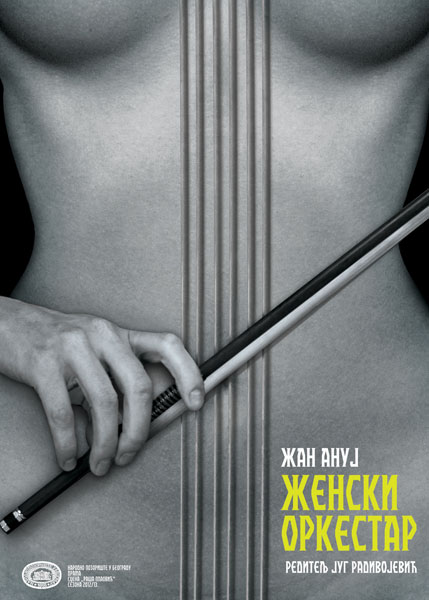
Jug Radivojević about directing Anouilh’s play The (Women’s) Orchestra
ABOUT ARTISTS AND MARKET
How did you choose to produce The Women’s Orchestra?
The Management offered the play to me in June this year. When I read it again, first time after my student days, I jumped to conclusion that I do not see a reason to stage this play today and the first impulse was to thank the Management for their offer. However, experience has taught me that I should sleep on it… I woke up during the night thinking about the atmosphere of the play… and that morning, I got up with a unique feeling regarding the play, the feeling I could not rationalise. I asked Mrs. Molina Udovički, Director of the Drama, for additional day or two to think about the play. I still didn’t have the idea what I would do with the Anouilh’s piece, but I already knew that the atmosphere in it, which attracted me, has a secret. I found the answer in the direct connection of the play with our present and in formulation of the thematic-idea circle. After having important discussions about the piece with Ivana Dimić, a dramaturge, and Vlado Pejković, a composer, I managed to articulate my initial feeling and to form an idea. The three of us soon came up with a subtitle to the play The Women’s Orchestra – Artists in the Market! That was it! I called the Management to say that I have the idea how to produce it and that I accept their offer.
This is the idea of your production. What about the theme? How much change has there been to the original text according to your concept?
From the comedy in which women’s orchestra composed of grotesque characters entertains convalescents in a spa, I created an expressive drama of psychological realism in which musical dramaturgy has been set similar to Brecht’s song in which each character has its own subjective musical monologue. The theme is about the destiny of artists today. It is about musicians of a symphony orchestra who were notified by a representative of the Government, at the very beginning of the play, that the orchestra would not receive Government’s funding in future, because institutions that do not bear profits cannot be funded any more and that the orchestra shall be left to its destiny in the open market. The dramaturge, Ivana Dimić, and I kept the characters, their relationships and their personal histories from the original, but we have placed them in new circumstances in the adaptation. Most part of the original text by Anouilh was kept, only the small portion of it was adapted. We created new circumstances that changed the genre and style and created new conditions for acting and interpretations.
It is obvious that you think it is important to produce a specific play in a specific moment and that this will be of great importance for the production…
The moment we live in imposes the type of plays I produce. This is how I choose the texts, in relation to the times and themes which are important to all of us, and for me personally. They, of course do not have to be political, but they have to be the themes which are of importance to us at a given moment, and which demand from us, the artists, to express certain attitudes and messages. In our line of work, there is no theme more important than the one we deal with in The Women’s Orchestra. The ongoing issues we are facing are reforms in culture, relationship of the Government towards artists, relationships between artists themselves, relationship between institutions of culture and the so-called market towards the artists, etc.
You are being very particular about organisation. Why do you have schedule of all rehearsals until premiere at the very beginning of preparations?
I always have a clear vision at the beginning. I make a firm plan in which I leave plenty of space for all my associates’ creativity. I believe that discipline and order are basic preconditions for creation. The Women’s Orchestra will be my 97th premiere in the career. I do not back out from my concept, now I dare say, of perfect organisation of the whole process, in which, at the very beginning, there is a comprehensive program of preparations until the premiere; the date of the premiere has been set before the first rehearsal takes place. This kind of organisation enables everyone to plan their own processes of work, there is no congestion, instead there is dissemination of work, the actors are aware what the program is for the day; I have been working like this since my graduation production. When theatres get the plan at the beginning of the production process, many are doubtful if it is possible to implement such plan, but in the end, they do not hide their delight and respect for this type of organisation.
The composer is very important in the production. What was your cooperation like?
Cooperation with Vlado Pejković, a composer, was of essential importance in formation of the play’s concept. His idea about songs, which are personal confessions, solved a problem that was not easy to settle. Of course, Ivana Dimić wrote original lyrics for the purpose of the play… I believe that music gave base and also a roof for this production.
Do you keep audience’s future reactions in mind while directing?
I always think about audience. I like and respect them. I cannot say that I create only for them, I do it for myself as well, but my every production speaks to audiences with the idea to bring them back to theatre, in order to touch their emotions, to excite them or make them happy… The audiences will relate extremely well with this play, because we find it very important that the public understands and supports artists.
What is your relationship towards actors and their creativity?
I come from the family of actors. I grew up in theatre, made my first steps on stage, met generations and generations of actors. I looked at them with admiration, asked for their autographs and later on, I started working and socialising with them. I teach students at the Department of Acting at FDA… I believe that I understand actors; I love and respect them… In my productions, they are more than equal partners; they are authors whom I deeply trust. Having faith in actors represents complete liberation of their creative expression.
Jelica Stevanović
JEAN ANOUILH ON STAGE IN THE NATIONAL THEATRE
TRAVELLER WITHOUT LUGGAGE, a play in five acts. Translation by Radoslav M. Vesnić. Directed by Radomir Plaović. Set design by Milica Bešević. Premiered on 16 December 1937.
BECKET, a play in two acts. Translated by Milan Puzić. Directed by Braslav Borozan. Set design by Vladimir Marenić. Costume design by Dušan Ristić. Musical score by Vojislav Kostić. Premiered on 9 February 1969.
MADEMOISELLE COLOMBE, a comedy in two acts. Translated by Soja Jovanović. Directed by Borislav Grigorović. Set design by Miomir Denić. Costume design by Ljiljana Dragović. Premiered on 16 December 1971 (Stage in Zemun).
MARIE JEANNE’S HANDS (THE CAVERN), a play in two acts. Translated by Dragoslav Andrić. Directed by Predrag Dinulović. Set design by Vladislav Lalicki. Costume design Ljiljana Orlić. Music selection by Zvonimir Jovčić. Premiered on 15 May 1976 (Stage in Zemun).