MIKIS THEODORAKIS
Composer, activist, politician, intellectual, and an eternal fighter for freedom, justice, and equality.
He was born on July 29, 1925, on the Greek island of Chios. Even as a child, he decided to become a composer; it is known that he held his first concert at the age of only 17, when his first symphony, Kassiani, was performed. He began his musical education in Athens. A significant part of his oeuvre is inspired by ancient themes, and his ability to unite elements of Hellenism with Byzantine tradition contributed to his distinctive artistic signature, placing him among the most prominent contemporary composers.
He was fully devoted to the Greek people and to the ideals of justice and freedom. He was an active participant in the Resistance Movement during World War II. He was arrested in 1943 and subjected to horrific torture and abuse. Barely survived exile in penal colonies.
In 1954, he moved to Paris, where he continued his musical training at the Conservatory until 1959, studying conducting with Eugène Bigot and composition with Olivier Messiaen. In a short period, he achieved remarkable success in Paris, London, and Moscow, establishing himself as a prominent international composer. At the World Festival in Moscow in 1957, he was awarded the Gold Medal in the composers’ competition. He also won the First Prize of the International Music Council in London in 1959, and that same year was recognized as the best young composer in Europe, receiving the prestigious Copley Award. During this period, he composed extensively for ballet.
With his song cycle Epitafios, in which he fused folk music with Greek poetry, he initiated a cultural revolution in Greece. In the 1960s, he met Fidel Castro and Che Guevara. As a symbol of resistance, he composed music inspired by the works of major left wing poets such as Pablo Neruda, Federico García Lorca, and others.
This successful period was interrupted by the intense clashes between right wing and left wing factions in Greece. After the assassination of the leading left wing politician G. Lambrakis in 1963, Mikis Theodorakis founded the Lambrakis Democratic Youth, and a year later entered the Greek Parliament. During this time, he achieved great success and worldwide fame with his music for the film Zorba the Greek and the oratorio Axion Esti. He performed across the globe and consistently advocated for the Greek people’s civil resistance and the fall of the dictatorship.
In 1967, the military junta seized power in Greece, banning the performance and sale of Theodorakis’s music, and he was arrested. His songs were listened to in secret and became a symbol of the Greek people’s resistance. He spent several years under house arrest, in exile, and in prison. His entire family — including his wife and two children — endured severe torture and inhumane treatment during this period. He went on several hunger strikes and came close to death, and his health was permanently damaged due to the harsh prison conditions.
He was released only in 1970, under strong pressure from the international community and through the efforts of major world artists such as Dmitri Shostakovich and Leonard Bernstein. He and his family were sent into exile in Paris, where they spent the next four years. After the fall of the military junta, he returned triumphantly to Athens on July 24, 1974, where he was welcomed as a national hero. Alongside his successful musical career, he continued his political engagement.
He left behind an enormous musical legacy comprising more than 1,000 works, including five operas — the most notable being Medea, Electra, Lysistrata, and Antigone — as well as three ballets, hymns, and numerous pieces of symphonic, chamber, choral, film, and theatre music.
Most significant film scores: Zorba the Greek (1964, dir. M. Cacoyannis — Grammy Award, Golden Globe nomination)
Z (1969, dir. C. Gavras — BAFTA Award for Best Original Music)
Serpico (1973, dir. S. Lumet — Grammy and BAFTA nominations)
The Battle of Sutjeska (1973), a Yugoslav partisan film directed by S. Delić
He also wrote dozens of books, many of which have been translated into various world languages.
Mikis Theodorakis was a great friend of the Serbian people. In 1999, at a massive rally in Athens, he expressed strong protest against the NATO aggression on Serbia.
He received a large number of major awards and honors. By decision of François Mitterrand, then President of the French Republic, he was awarded the Order of the Legion of Honour in 1996. He was nominated for the Nobel Peace Prize in 2000. In 2005, he received the UNESCO Award for Music and Art. He was also highly recognized in academic circles: he was named Honorary Professor at 11 Greek and international universities and received four gold medals from Greek universities. He became an Honorary Member of the Academy of Athens in 2013. A few months before his death, he was awarded Greece’s highest decoration — the Grand Cross of the Order of Honour.
Mikis Theodorakis was a symbol of resistance to dictatorship, a tireless fighter, and above all, an exceptional artist who spoke through his music.
He passed away in Athens on September 2, 2021, and after three days of national mourning, he was laid to rest.
Brankica Knežević
Synopsis
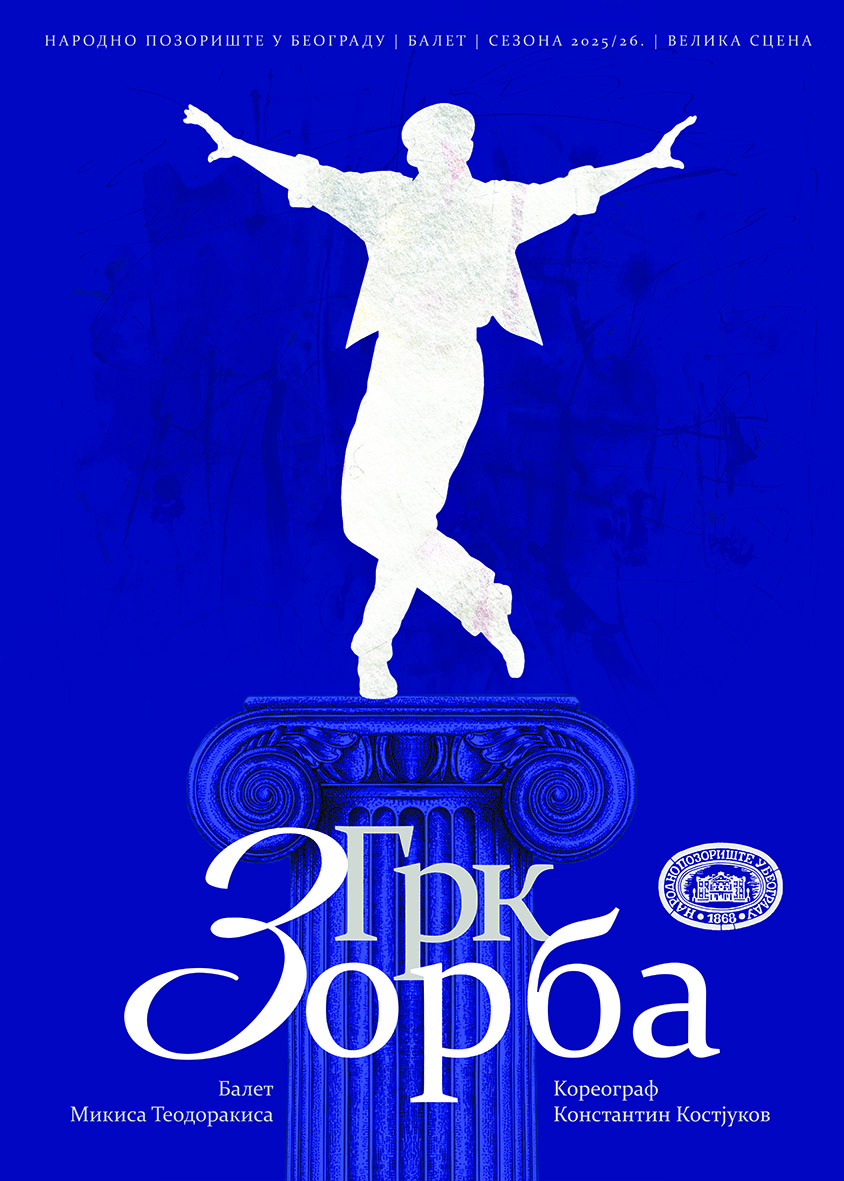
In the Greek port of Piraeus, a fateful encounter takes place between two completely different men: Nikos, a young Greek intellectual determined to change the course of his life, and Alexis Zorba, a tireless wanderer and miner. Nik is traveling to Crete, where he has rented an abandoned lignite mine. He wants to escape his former life, filled with spirituality and writing, hoping to discover new paths and find peace among ordinary people. Without realizing it, he meets on the ship the man who will become his new life teacher – Zorba, the embodiment of a person overflowing with passion and courage, qualities unknown to Nik. His world revolves around literature and philosophy, while Zorba will teach him how to break free from rigid patterns and experience all the passions of life in the present moment. Alexis Zorba loves women, music, and wine. He shows exceptional tenderness only toward his santouri, an instrument he respects as a living being and guards with ritual devotion. Zorba’s raw nature will profoundly influence Nik’s transformation.
*I realized that this Zorba was the man I had been searching for so long and could never find; a living heart, a warm voice, a great untamed soul that had not yet severed the umbilical cord from its mother, the Earth.
Upon arriving on the island, they are greeted by the beautiful Cretan landscape, the endless sea, and the vibrant local community. Life unfolds in the village square, pulsing with dance and music. Among the many villagers, special attention is drawn to Marina, a young widow – mysterious, beautiful, and desired by the men, yet she remains distant. Pavlis, the village elder’s son, is obsessed with her, but she rejects him, and his love soon turns into jealousy and despair. A quiet yet powerful attraction develops between Nik and Marina, something the villagers quickly notice. Their growing closeness awakens anger and resentment within the community, foreshadowing a tragic outcome. Nik is torn between his desires and his fears, but Zorba – his guide through life – encourages him to follow his heart. Among the villagers is Madame Hortense, the first to welcome Nik and Zorba upon their arrival in Crete. Once a Parisian singer and dancer, now in her late years, she is weary from a turbulent life, many romances, and filled with nostalgia and unfulfilled dreams. She owns a modest boarding house where she lives surrounded by memories. Her encounter with Zorba rekindles in her a spark of passion and love. She gives herself to him completely, while his feelings toward her are a mixture of tenderness and a touch of pity.
When Zorba leaves on a short trip that unexpectedly becomes much longer, because he cannot resist his passions, he eventually returns to the village cheerful and smiling, bringing gifts for his friends, Madame Hortense and Nik, who is angry about Zorba’s long absence. Yet Zorba’s infectious energy disarms him, and especially delights Madame Hortense, who lives for the moment of his return. What follows are moments filled with love, celebration, and finally, their wedding. The joy does not last long. Young Pavlis, devastated by unrequited love, sinks into despair and takes his own life. This tragedy becomes the trigger for the villagers’ collective fury. The love between Nik and Marina becomes public, And fatal at the same time. The primitiveness and prejudice of the harsh villagers lead to brutal punishment, and the young woman is killed before Nik’s eyes. He remains a silent witness to the tragedy. At the same moment, Zorba’s world collapses as well. Madame Hortense, weakened by illness, dies in his arms.
Zorba’s unstoppable energy does not allow despair to prevail. Beside him stands Nik, who, despite the tragedy, has learned to embrace life fully. Nik and Zorba begin to dance, as an act of defiance against fate, a response to pain, a celebration of life itself, in spite of everything. And as their steps grow faster, it becomes clear that life and death are parts of the same whole.
* I saw Zorba dancing, and for the first time I felt the demonic rebellion of man – the urge to conquer weight and matter, that primordial curse. I was proud of his endurance, his strength, his fierce dignity; on the sandy shore, those aggressive yet artistic steps of Zorba traced the Luciferian history of humankind.
Brankica Knežević
Konstantin Kostjukov
*Nikos Kazancakis, GRK ZORBA – Život i narav Aleksisa Zorbe, Dereta, Belgrade, 2022
Translation from Modern Greek: dr Vladimir Bošković
KONSTANTIN KOSTJUKOV – choreographer
After completing his ballet training in Kyiv, he joined the Ballet of the National Opera of Ukraine, where in 1987 he was awarded the title of Principal Dancer. Since 1991, he has been engaged as a principal dancer with the Ballet of the National Theatre in Belgrade. The same year, he won the First Prize at the 4th World Ballet Pairs Competition in Osaka, Japan.
He graduated from the International Theatre Institute of Ukraine in Kyiv in 2001, Department of Ballet Pedagogy. He earned his master’s degree in Choreography at the University in Kherson (Ukraine).
From November 2004 to 2011, and again from November 2012 to February 2022, he served as the Director of the Ballet of the National Theatre in Belgrade.
First roles at the National Theatre
Swan Lake (D. Parlić) Giselle (L. Lavrovsky)
Don Quixote, The Sleeping Beauty, Carmen, Autumn Rain, Dr. Jekyll and Mr. Hyde (V. Logunov), The Fountain of Bakhchisaray (R. Klyavin)
Samson and Delilah, Resurrection, The Lady of the Camellias, Scheherazade, Woman, Images,
The Poet Tchaikovsky, Impure Blood (L. Pilipenko)
The Rite of Spring, Wolves (D. Seifert), Romeo and Juliet (A. Shekera)
Odysseus (L. Lambrou), Queen Margot (K. Simić), Autumn Flowers (M. K. Pietragalla)
He has performed extensively on regional, European, and international stages.
As an assistant choreographer, he worked on the ballets Wolves by D. Seifert and Romeo and Juliet by A. Shekera.
He served as expert consultant during the filming of The White Crow, directed by Ralph Fiennes, in 2017.
Choreography works
Aida — (Opera Timișoara. 2003; National Theatre in Belgrade. 2013)
The Nutcracker (2014), Swan Lake (2019) — National Theatre in Belgrade
Romeo and Juliet (2014) — Serbian National Theatre, Novi Sad
The Nutcracker (2017) — National Theatre, Sarajevo
Swan Lake — National Ballet of Panama (2025)
Most significant awards
Davidoff Award for contemporary theatrical expression (1989)
National Theatre in Belgrade Award for leading roles (Swan Lake 1991,
Don Quixote 1992, Scheherazade 1994)
October Award (1994)
Ministry of Culture of the Republic of Serbia Award for artistic contribution (1995)
International Theatre Institute of Ukraine – Anatoly Shekera Award (2002)
Golden Link (2003), Vuk Award (2007), BK Award (2015)
Seal of the National Theatre (2019), Plaque of the National Theatre (2021)
Gold Medal for achievements in the field of ballet art (2023)
1946 – First edition of Nikos Kazantzakis’s novel Zorba the Greek
1957 – Nikos Kazantzakis nominated for the Nobel Prize in Literature
1964 – Theodorakis composes the music for the film Zorba the Greek. The film wins 3 Oscars
The famous sirtaki dance did not exist before the film Zorba the Greek — although it contains elements of traditional Greek folk dances.
It gained cult status and became one of the most recognizable symbols of Greek culture.
1987 – Commissioned by the Verona Festival, Theodorakis composes the music for the Zorba the Greek ballet
1988 – Ballet premiere, choreographed by Lorca Massine, in the magnificent Verona Arena before 18,000 spectators. Mikis Theodorakis conducted.
1994 – Premiere of the Zorba the Greek ballet at the Serbian National Theatre in Novi Sad. Mikis Theodorakis was the guest of honor.
1997–2013 – Konstantin Kostjukov performed Zorba the Greek nearly one hundred times